
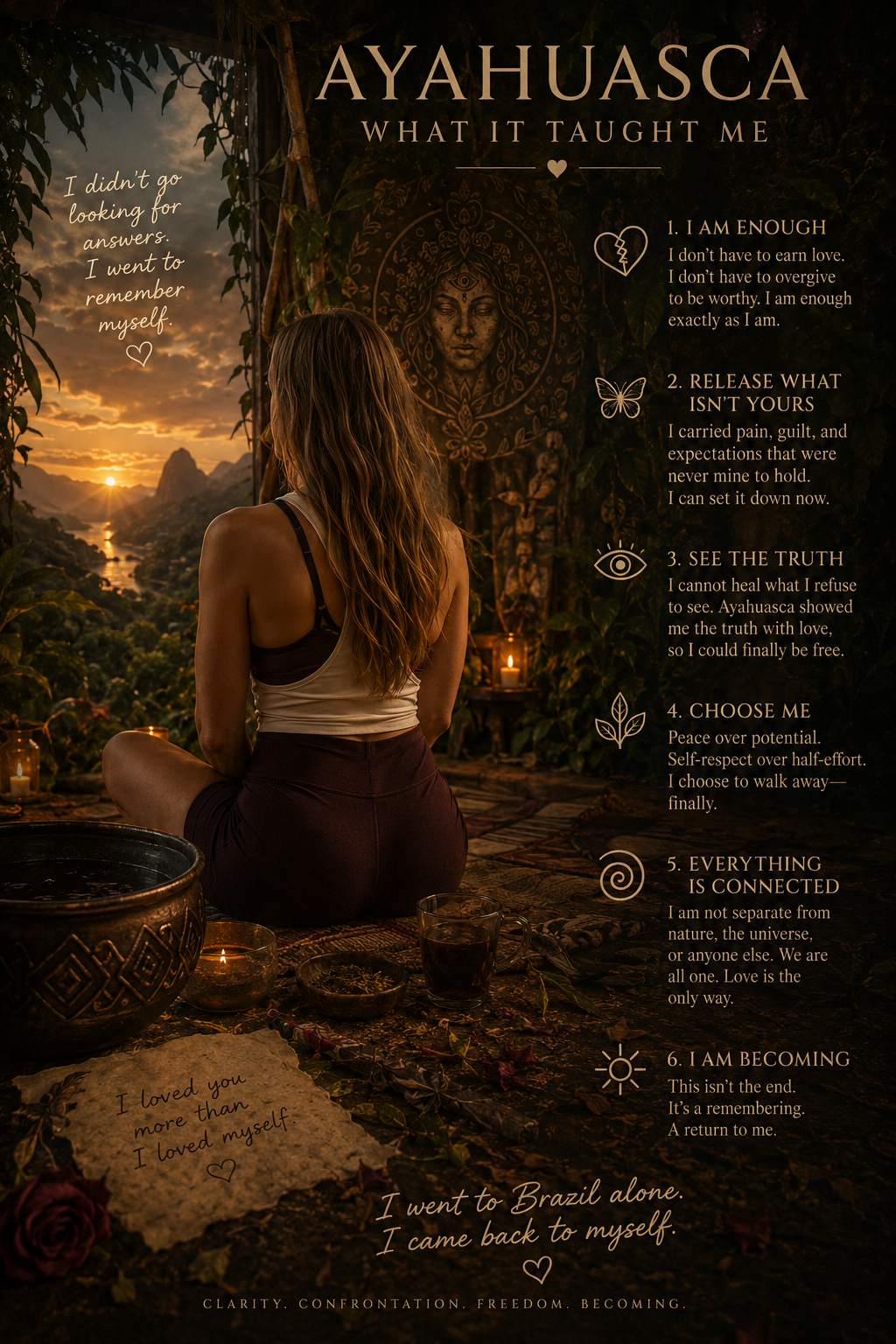
Almost everyone asked if I was scared to travel to Brazil—much less attend an ayahuasca ceremony—alone.
But the thought of being afraid never occurred to me. Whatever is meant to happen will happen. And, of course, my father assured me that if I were taken by sex traffickers, they would certainly return me within three days. Though, at thirty-five, I believe I have miraculously aged out of that particular demographic… However, I could still be a viable candidate for organ harvesting or as a drug mule, at least. Alas, one future aspiration age and diminishing beauty have not yet managed to rob me of.
I digress.
If anything, being alone felt poetically fitting. I’ve walked through nearly every defining moment of my life on my own. This was no different—just more intentional.
And when someone tried to invite himself into the experience, something in me resisted immediately. Not out of fear… but out of a deep sense of knowing.
This wasn’t meant to be shared.
Some journeys aren’t about companionship.
They’re about confrontation.
Clarity.
Becoming.
And I wanted this one—entirely, unapologetically—my own.
On Wednesday, as I drove to the Baltimore-Washington International Airport, I could feel Brazil’s pull—seductive, certain, and entirely inescapable—a siren I had no intention of resisting.
There was a quiet sense of alignment in it all, as if the Universe had already arranged each step before I ever took it. Every leg of the journey unfolded with an ease that felt almost deliberate—too precise to be coincidence.
A two-and-a-half-hour drive to BWI.
A three-and a half-hour hour flight to Houston.
And then, the long stretch—a ten-and-a-half-hour flight to Rio de Janeiro.
Somewhere along the way, luck—or perhaps something more intentional—made space for me. The seat beside me remained empty, and for a few rare hours, I stretched out fully, suspended somewhere between departure and arrival, between who I had been and who I was becoming. It helps, I suppose, to be fun-sized when the world offers you a tight space to fit into—a personal luxury not everyone around me could enjoy. After watching The Maid, I popped some Zzzquil and was able to knock out for a blessed eight hours.
When I awoke, my body felt like it was made of pure potential energy, just waiting to erupt.
The only thing that gave me pause wasn’t the journey—it was the logistics: the fear of unreliable WiFi, unfamiliar airports, and a level of Portuguese that might get me a coffee… but not much else.
A pronto! Zen was to the rescue and found me waiting expectantly inside the airport, the lost lamb in need of a shepherd.
When I arrived at my future residence—a two-story, hostel-style structure Zen and his group had built by hand—I was immediately pulled into orbit.
Ligia. Jill. Lucas. Chris. Lila. David. Arjouna.
Names that, within minutes, became voices, laughter, energy.
Everyone was disarmingly kind—welcoming in a way that felt immediate and unguarded, as if I had arrived somewhere I was already expected.
There was no easing in.
Conversation began the moment I stepped inside and didn’t stop.
Each person came with stories—not one, but a rapid-fire succession, as if they had been waiting for the opportunity to be told. Five stories deep before you could even respond to the first.
And I listened.
More than I usually do.
It felt important to.
Because in that flood of anecdotes—layered, overlapping, sometimes chaotic—I began to understand them quickly. Not just who they were on the surface, but how they moved through the world.
In a matter of hours, strangers became something closer to familiar, and by the end of it family.
Not through time—but through volume.
The first night, I was introduced to rapé.
A preparation of sorts—for what was to come the following evening with ayahuasca.
Pronounced ha-peh, it is a sacred ceremonial snuff used by indigenous tribes of the Amazon. A fine, earthy powder made from mapacho tobacco—nicotiana rustica, far more potent than anything I had encountered before—blended with ash from sacred plants or tree bark, each mixture unique to the tribe that prepares it.
The rapé is believed to clear negative energy, ground the mind and body, enhance focus and awareness, open spiritual connection, and align intention and presence.
But no description quite prepares you for how it’s given.
It isn’t taken.
It’s delivered.
Forcefully.
Through the nostrils.
Using a small pipe—either a tepi, administered by another, or a kuripe, used on oneself—the powder is blown deep into the nasal passages in one sharp, deliberate burst.
There’s no easing into it.
No gentle introduction.
Just breath—
and then impact.
Truth be told, it burned like hell.
Instantly.
Disorienting in a way I wasn’t prepared for—my body reacting before my mind could catch up. Sweat broke across my skin, my heart started racing, and I struggled to pull air through my mouth, forcing myself not to breathe through my nose like I’d been instructed.
It wasn’t optional.
There was no easing into it.
And then—before I could fully recover—I had to suck it the fuck up, Buttercup, and do it again.
Other nostril.
No sympathy. No pause. Just get through it.
My hands and feet began to buzz, a sharp, electric hum coursing through me from the sheer intensity of the nicotine. It felt like my entire body had been plugged into something too strong, too fast.
By the time I made it back to my room—finally feeling steady enough to walk—I couldn’t hold it anymore.
I barely made it to the toilet before my body took over—purging again and again, relentless, leaving me shaking and emptied out.
Part of it was the rapé.
Part of it, I think, was everything else.
I changed out of the tennis dress I had so confidently—and incorrectly—chosen for the night, trading it for something loose, something that didn’t feel like it was suffocating me.
Because at that point, comfort wasn’t a luxury.
It was survival.
At 10 PM the following evening, we began the ayahuasca ceremony.
It opened in reverence—prayers whispered into the dark, blessings passed from hand to hand, and the slow, deliberate sweep of sage smoke curling around each of us, as if preparing our bodies for something we could not yet understand.
Then Zen came around with the medicine.
Tiny paper cups. Unassuming. Almost laughable, considering what they held.
We set our intentions in silence—or something close to it—and then, without ceremony, we threw it back like a shot.
It was, without exaggeration, one of the most revolting things I have ever tasted. Thick. Bitter. Ancient. The kind of flavor that doesn’t just sit on your tongue—it clings.
Thank God for Jill, who had the foresight to bring grapes. Sweet, cold, immediate relief. A small mercy in what already felt like the threshold of something much larger.
And then the chants began—woven in the indigenous languages of the Huni Kuin, Shanenawa, Yawanawa, and Noke Kuin.
Languages I did not understand, yet somehow felt.
They moved like currents through the room—ancient, rhythmic, alive—settling not in my mind, but somewhere deeper in my body, as if they were speaking to something in me that existed long before language ever did.
Low at first. Rhythmic. Intentional.
They weren’t just songs—they felt like instructions. Like keys turning in a lock.
The sound moved through the room, through our bodies, through the medicine itself—activating it, awakening it—carrying us somewhere we had all agreed, perhaps foolishly, to go.
The chanting would continue until dawn.
Hours later, the tone would shift—songs rising, instruments joining, something almost celebratory weaving itself into the night.
But in those first moments, sitting there with the taste still lingering and the air thick with smoke and sound—there was no turning back.
Unfortunately for me, I was a difficult case—I wasn’t connecting.
Nothing.
While others began to drift, to soften, to surrender—I stayed exactly where I was. Clear. Aware. Stubbornly untouched.
So Zen gave me another dose.
We waited an hour.
Still nothing.
Another dose.
Another hour.
Nothing.
By the third, it was no longer patience—it was persistence. Or maybe defiance. Mine, or the medicine’s—I couldn’t tell.
After the fourth dose, I finally felt something, like I was beginning to fall slowly down a slide. And away I went.
With my eyes closed, the darkness gave way to a kaleidoscope—colors fracturing into intricate geometric patterns, folding in on themselves like something alive.
Very similar to the effects of shrooms—psilocybin—I found myself acutely disappointed, a blooming panic beginning to unfurl in my chest as I marveled at the possibility that I had just flown halfway across the world for something I could have sourced from the very man whose existence drove me to come here in the first place and experience in the comfort of my own home.
I couldn’t help but think: This is it? This is what I came for? I even reached out to the Joker to say, “Well, you were right. I must be impossible to please.”
And then, as if summoned from memory, he appeared.
A familiar presence—one I had encountered before in altered states. A green, deity-like figure, reminiscent of something Hindu, with a long, curved trunk—his appearance reminding me of the dancing slave woman Jabba the Hutt devours in Return of the Jedi.
He didn’t speak.
He didn’t need to.
The intensity of his interest made me feel shy—almost nervous beneath the full weight of his attention.
There was something undeniably playful about him—an energy that felt both ancient and mischievous. He radiated a kind of sensual confidence, as if he embodied permission itself… a quiet insistence that desire, in its purest form, was not something to suppress, but something to understand.
It wasn’t overt. It wasn’t aggressive.
But it was magnetic.
Disarming.
And strangely intimate in a way that made me feel seen—almost too seen.
And just as quickly as he arrived, he left me there—aware of myself in a way that felt both empowering and… embarrassingly vulnerable.
Bashful, even.
Especially considering, somewhere in the distance of my awareness, I knew there were multiple people around me watching for signs of distress.
God, how mortifying it would have been if they had noticed my arousal. Though, in hindsight, I now possess a far greater sense of empathy for any man burdened with a troublesome erection at a deeply inconvenient time.
Then, there was another.
This one carried a darker presence—manic, volatile, almost feral in its energy.
His face was grotesque, distorted into something that felt more like a caricature of fear than fear itself—like a Halloween mask pulled too tight over something alive. He snarled, over and over again, “Impressed now? I’ll haunt your dreams, bitch!”
The words should have unsettled me.
But they didn’t.
I wasn’t afraid of him.
If anything, I was… entertained.
We clashed—not physically, but mentally—like two forces testing each other’s strength. He pushed, I pushed back. Again and again. And with each pass, it became clearer: he wasn’t as powerful as he wanted me to believe.
And I knew it.
What should have been terrifying felt almost… playful.
A game.
And I was winning.
My next visitor was God.
She came in a feminine form—unmistakable in presence, undeniable in authority—but not soft.
Not at first.
She was sharp. Unyielding. Exacting.
And she went straight for the wound.
Every fear I had carried about the Joker—every cruel thought I had ever turned inward on myself—she gave voice to it. Not gently, not symbolically, but plainly. Brutally.
Why he treated me the way he had.
Why I allowed it.
Why, somewhere deep down, I believed I deserved it.
It was all there—laid out in front of me with nowhere to hide.
And for a moment, it burned. It enraged.
But then something shifted.
The weight of it—the sheer extremity of what was being said—collapsed in on itself.
And I started to laugh.
Because I could see it for what it was.
Not truth.
Distortion.
A collection of every lie I had ever ruminated over in the quiet moments when I was alone with my own doubt.
And in seeing it so clearly—so loudly—I knew, without hesitation, that none of it was real.
I didn’t deserve that treatment.
I never had.
And she knew that I knew.
That was the point.
The edge in her softened then—not into comfort, but into clarity.
What followed wasn’t gentle. It wasn’t sugar-coated.
It was honest.
Direct.
A conversation, stripped of illusion, about how I had been treating myself—and how that, more than anything, had set the standard for what I allowed from others.
She didn’t comfort me.
She corrected me.
And somehow, that felt like love.
So, what did I learn?
I have come to understand that there is a difference between honesty and transparency. And here, the conversation must turn directly to you, Joker. Perhaps you can claim you have always been honest with me — though I can no longer say with certainty that even that is true — but you have, without question, failed to be transparent with me. And now, at last, I understand both what I value and what I should demand.
And it was here that I had a Kubla Khan moment and afterward found myself without the thread of the tapestry I had been weaving, left in a painful state of partial completion. My hiatus lasted several weeks before a song I became fixated on rebirthed the seed of inspiration, and the words once again flowed true from my mind.
Listen to “Do I Wanna Know?” by Arctic Monkeys, an English rock band with a lead singer I find devilishly mesmerizing — his voice best heard whispering sweet nothings deep into one’s ear — and a matching dreamy vintage aesthetic that not only engorges the eyes, but riles the senses beyond reason. I was captivated by all of it for days, listening to the song on repeat before the lyrics finally struck a different, darker chord — one my heart had already been resonating with, though it wasn’t until then that my head finally caught up…
So have you got the guts?
Been wonderin’ if your heart’s still open
And if so, I wanna know what time it shuts
Simmer down an’ pucker up, I’m sorry to interrupt
It’s just I’m constantly on the cusp of tryin’ to kiss you
But I don’t know if you feel the same as I do
But we could be together if you wanted to
A great summation of our relationship. Here I am — or rather, here I have been — the obsessed lover, paranoid about a relationship that does not exist. But it was in the rhetorical questions Alex Turner asks that I finally heard what my heart had been answering for God knows how long:
(Do I wanna know) If this feelin’ flows both ways?
No. I so desperately did for so long, but no, I don’t. The idea is, in fact, horrifying to me now: to be lost in that sick turbulence of determined devotion, unmet emotional need, and indifferent neglect.
No, I don’t want to know if the Joker still — or ever — felt the same. The vehemence I feel is directly parallel to the phobia I have of cigarettes and smoking: sheer, unbridled terror at ever doing anything that could precariously place again me in the thralls of its power.
(Sad to see you go) Was sorta hopin’ that you’d stay
Let’s not downplay it here. I was devastated to see you go and would have gladly played the martyr, sacrificing myself to appease your chosen whims to my own detriment. The nonchalance is cute, but I wasn’t just “sorta hopin’ you’d stay.” I envisioned a lifetime with you, whether as lovers or best friends, my desperation blinding me to the truth.
(Baby, we both know) That the nights were mainly made
For sayin’ things that you can’t say tomorrow day
Erroneous! We both know I would never say anything I didn’t mean with all my heart, nor use the excuse of night or intoxication to finally unleash my words. We both know I kept a tight leash on so much of what I needed to say to you in order to spare your feelings and not needlessly wound a man I couldn’t be certain deserved my wrath, despite inflicting so much pain upon me.
Though I was built to endure the greatest and darkest onslaughts, that does not mean I deserve them. Whether by ignorance or by design, the Richter scale can only measure the magnitude of the damage wrought.
(Do I wanna know?) Too busy bein’ yours to fall
(Do I wanna know?) Do you want me crawlin’ back to you?
Jesus Christ, how could I not see what is now so painfully obvious? I am incapable of giving anyone a chance, much less falling for them, when I have been hopelessly yours for over half a decade. But, as Daniel Sloss once said, would I rather accept this time as wasted, or continue wasting the rest of my life?
(Sad to see you go) Ever thought of callin’, darlin’?
And therein lies the rub! No, you haven’t. You only wanted me because I bring a kind of magical devotion to the people I love. You — we — were never the magic. I was.
But you don’t truly care. You never did. You don’t call. You don’t text. You don’t send me memes anymore. You only reach out when you’re worried I’m no longer interested.
You say you haven’t changed, and the truth is, I realized you were right. You haven’t.
It’s me — I have. And I can no longer unsee, much less stomach, the bare minimum from people. You say you’ve also been such a great friend to me? Fucking prove it. Tell me what your track record extends to outside of the moments when I made things convenient for you.
You rarely showed up for me, and before you try to argue otherwise, if you extol never having a closed door to someone as some great virtue of friendship, kindly remember how welcoming me into your home would somehow have violated the sanctity of your relationship.
(Do I wanna know?) Do you want me crawlin’ back to you?
For the love of God — more importantly, for the love of me — no. Jesus, I really have been crawlin’ back to you every time, like some masochistic puppy that truly believed you meant it when you said you loved me. Not only have I degraded myself, I have done myself a great disservice.
And the acrid truth I taste from the dregs of your love sitting in my stomach is this: you can never love someone enough that they will begin to love themselves in the process. They will only judge you for loving them so blindly and whether inadvertently or not string you along because they enjoy how it feels to be viewed through your eyes, all while continuing to seek someone else’s comfort — someone not so desperately naive that they can actually take seriously.
So…
Have you got colour in your cheeks?
I can only hope it’s from the shame you feel for the way you treated me.
Do you ever get that fear that you can’t shift the type
That sticks around like summat in your teeth?
Thank God, no, I don’t have that fear anymore. As hard as it was, I am so grateful that I finally understand this pattern I have been doomed to repeat — but never again, so thank you. I spit my unquestioning love for and loyalty to you from my mouth like plaque scraped from my teeth.
Are there some aces up your sleeve?
Have you no idea that you’re in deep?
I’ve dreamt about you nearly every night this week
How many secrets can you keep?
‘Cause there’s this tune I found
That makes me think of you somehow an’ I play it on repeat
Until I fall asleep, spillin’ drinks on my settee
Aces up my sleeve? Never. I don’t want anyone who doesn’t want me. And as clear as you made it how little importance I ever meant to you makes it only more embarrassing writing this piece, but I find power and resolve in truth.
It doesn’t matter now. Die with your secrets. While I lived to make you smile, you couldn’t even be bothered to send me a song you had on repeat. How pathetic I must have seemed, continuing to extend the olive branch when even that small effort of friendship was apparently either too taxing or too threatening to the woman you now keep.
Whatever. I deserve better, and we both know it’s true. And you can be damn sure that I will never come crawling back to you.


Leave a Reply